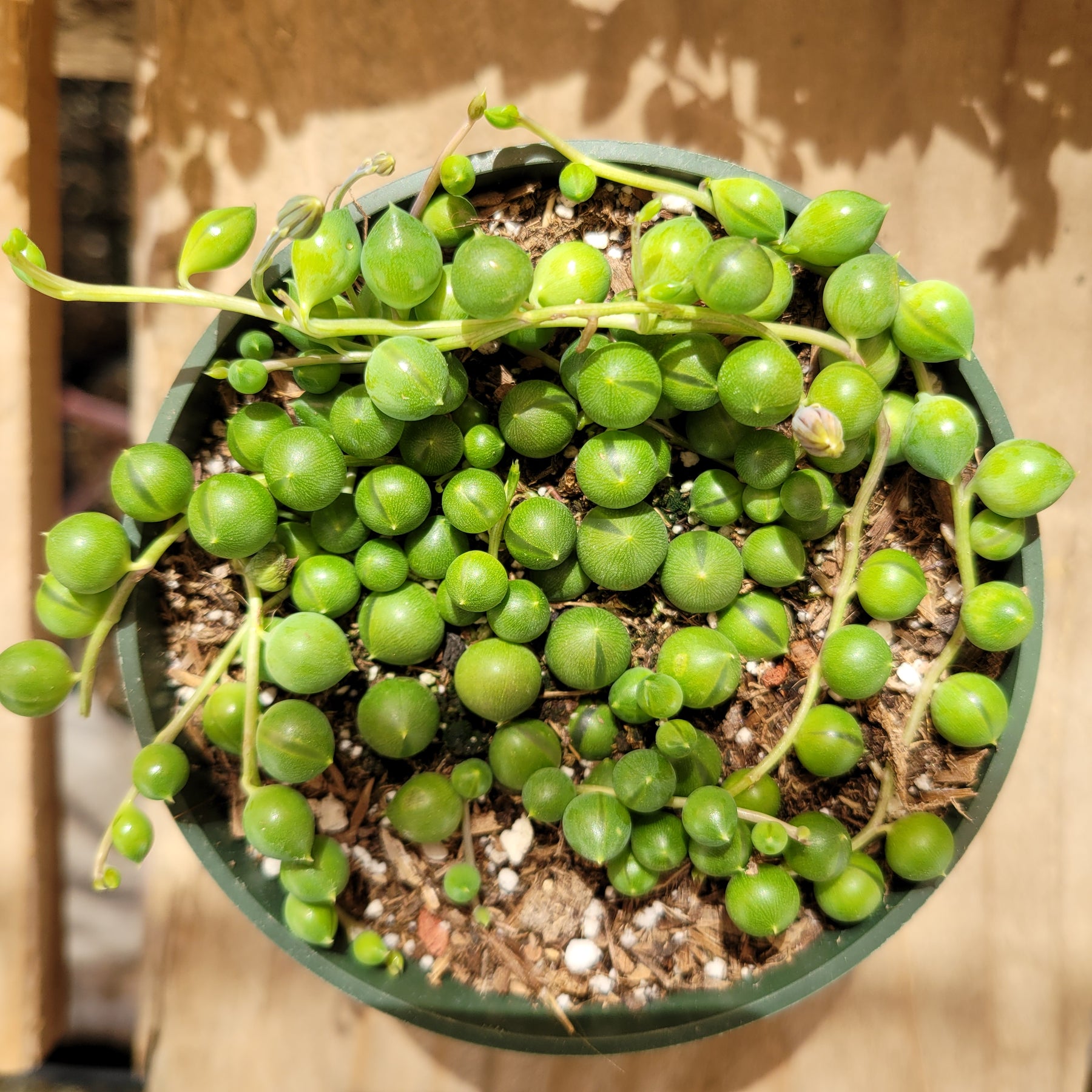
SKU: 46712460750
rowleyanus succulent

rowleyanus succulent String of Pearls Senecio rowleyanus

Sale price$22.96 Regular price$25.51
Save 10%

Pay in installments of $6.38 with ShopPay, AfterPay and Klarna

Shipping Estimate
USA
  • USA
  • CAN

Ships within 48 hours · Estimated delivery Aug 24 - Aug 29

Promo Codes Available:

For Your Every Summer RSVP, with Code: SUMMER15

Description

rowleyanus succulent String of Pearls Senecio rowleyanusString of Pearls is commonly grown as a houseplant or an outdoor ornamental in frost free climates. It is often grown in hanging baskets to allow the trailing stems to spill downward. It could also be grown in a flat dish, allowing it to maintain the trailing growth habit seen in the wild. Indoor containers can be moved outside for the growing season but need to be acclimated gradually to prevent sunburn, should be protected from excess rainfall, and

String of Pearls is commonly grown as a houseplant or an outdoor ornamental in frost-free climates. It is often grown in hanging baskets to allow the trailing stems to spill downward. It could also be grown in a flat dish, allowing it to maintain the trailing growth habit seen in the wild.

Indoor containers can be moved outside for the growing season but need to be acclimated gradually to prevent sunburn, should be protected from excess rainfall, and must be moved back indoors before frost.

The plant grows from weak surface roots, producing trailing stems up to three feet long on the ground which can root where they touch soil to form dense mats. It often grows under bushes or between rocks which provide some protection from intense sunlight. The alternate, water-storing leaves are the size and shape of small peas (each to 1/4” diameter) with a small pointed tip on the end and a thin stripe of dark green along the side.

The round shape of the leaves minimizes the surface area exposed to dry desert air and therefore reduces evaporative water loss but also reduces the surface area where photosynthesis can occur compared to a normal thin, flat leaf.


Care Tips

Light: Ideals are full to partial sunny locations or only bright locations directly behind a window.  The String of Pearls plant can spend the summer in the garden or on the balcony. There it must be slowly accustomed to the sun, which is no longer filtered through a window. Otherwise its leaves may burn.

Water: Senecio rowleyanus is a succulent plant and can store water in its thick leaves. It does not have to be watered until the soil is nearly dry. Water sparingly if placed cool to temperature during winter.

Soil: Not only a cacti mix is suitable, peat-free mixtures for indoor plants, herbs or vegetables can also be used. 

Temperature: A cool winter location at temperatures between 10 to 15 °C (50 to 59 °F) is required to get Senecio rowleyanus to bloom. However, it can also be wintered at room temperature. Minimum temperature is 5 °C (41 °F).

Potting: In the first year after purchase or repotting, Senecio rowleyanus does not require fertilization. Liquid fertilizer can be given every 4th to 8th week if the plant is actively growing. The growing season usually lasts from spring to autumn.

Humidity: Any average household humidity level is fine for String-of-Pearls, but try to keep it at about 50% or higher.


Shipping & Handling

    • The 2 Inch and 4 Inch String of Pearls plants are shipped with the pot and soil
    • The 6 Inch and 8 Inch String of Pearls plants are shipped bare roots without the pot and soil:
    • You will receive a very similar plant to the one shown in the photos; shape and color may vary
    • Ship within USA & its outlying territories only
    • Please visit Order Processing & Shipping info page for additional details


    Care Instructions

    Please visit our Succulent Care info page for more details.

    To ensure the health of succulents, it is important to plant them in porous, well-draining soil. Succulents require little watering, but don't like to sit in wet soil. To create an adequate cactus mix, simply add pumice, perlite, or grit to cactus soil to provide the proper drainage.

    Make sure to leave drought periods between waterings to prevent the plant from water-logging.


    Weather Conditions

    • When ordering, be mindful that living succulents can be damaged by the cold weather.
    • If you live in an area that is below 40 degrees Fahrenheit, please add a shipping warmer to your order or consider purchasing plant until the weather is more suitable.
    • Shipping Warmer: 72+ Hours Heat Packs available for $1.7 each
      Shipping Notes
      • Free Standard Shipping on $100+ Orders to the USA.
      • Except Preorder products are shipped in 48 hours.
      • Delivery to the USA:
      1. Standard Shipping : 3-10 business days
      • If time is of the essence, please consider selecting expedited delivery for faster service.
      Exchange/Return Notes
      • We offer a 30-day return/exchange service after receiving.
      • Final sale items are not eligible for returns or exchanges.
      • To process your return/exchange, please contact us at [email protected]
      • Please click here for more details>>> Return & Exchange Policy
      SKU: 46712460750

      Discover Niche Categories That Outsell rowleyanus succulent

      Top-Converting Item to Boost Your Average Order

      4.5 ★★★★★
      Based on 17 reviews
      Sort
      Highest Rating
      Newest First
      Oldest First
      Product Reviews
      P
      Verified Purchase
      pepe
      Louisville, US
      ★★★★★ 5
      interesting analysis of what 'being creative' really means
      This easy-to-read absorbing book is based on lengthy interviews with 91 creative individuals ranging from Nobel prize winners to artists to CEOs. Csikszentmihalyi starts by debunking the myth of 'the lone genius having a brilliant idea as if by magic' and defines three necessary ingredients for creativity ('with a capital "C"') - domain, field, and individual. Creativity must take place within a recognised domain (such as physics, painting and so forth); be recognised by experts in that domain (the field, although this may not happen in the individual's lifetime, eg, Van Gogh); and of course come from an individual, although he also adds the painstaking work that precedes and insight, the reality that all creativity builds on what has gone before, and the social elements of the creative process. The book also offers supporting evidence from the lives of the 91 interviewed, which also provides interesting insights into their lives. In many ways, this book is a biography of the creative individual. Also contains a chapter with quite practical guidance on how to live more creatively. Prescient advice for a book published in 1996 given the increasing profile creativity is getting in business and public life. HIghly recommended, one of the most interesting learning experiences i have had in a long while!
      WAS THIS REVIEW HELPFUL?YesReportShare
      Reviewed in the United States on February 5, 2013
      C
      Verified Purchase
      Charles H. Hooker Jr.
      Omaha, US
      ★★★★★ 5
      Very enlightening for those who truly appreciate creativity more than cleverness!
      Format: Paperback
      I love how the author almost redefines creativity .and sheds new light (for me, at least!)on what what real-for-true creativity is and how it benefits individuals and society. It's far more than simply brightening up a room with new wallpaper and curtains -- it describes how genuine creativity requires a thorough working knowledge of the fundamentals of any given field before one can truly create something new or better, and it reveals how those of us who aren't capable of creating something ourselves can yet be part of the process by demonstrating appreciation and support for those who create, whether as sponsors, patrons, or even just ardent fans!
      WAS THIS REVIEW HELPFUL?YesReportShare
      Reviewed in the United States on July 4, 2023
      D
      Verified Purchase
      Donald Walker
      Battle Creek, US
      ★★★★★ 3
      instructive but limited
      The testimonies of creative people that give this book its flesh and blood provide fascinating examples of creative people at work. That said, if a journalist had written the book, it would be more readable, and I don't think any less of an intellectual contribution. Moreover, the definition of creativity is elitist and stunts the topic (as observed by other reviewers): "Creativity is any act, idea, or product that changes an existing domain, or that transforms an existing domain into a new one. And the definition of a creative person is: someone whose thoughts or actions change a domain, or establish a new domain. It is important to remember, however, that a domain cannot be changed without the explicit or implicit consent of a field responsible for it." Given the people interviewed, much more needs to be said about the function of social institutions in promoting creativity. Many of the accomplishments lauded in this book would never have happened without grant-making agencies (e.g., NSF, NIH, HHMI) or non-profit employers like research universities and hospitals. To offer just one obvious example of the difference made by one's institutional context, the author had advanced students to help him do his research for this book. The elitism of the definition is even clearer in the role that marketplace plays as a judge of creativity. None of us buys books from amazon.com because some official group validated amazon.com as a good idea. We didn't wait for computer programers to affirm and certify it. Amazon.com is not deemed successful because it impressed its peers. It is successful because millions of us purchase goods through it. Similarly, auto-executives did not make the minivan a successful idea, millions of shoppers did. (Obviously I don't think the marketplace fits into the author's definition of creativity. If 300 million American consumers comprise a domain with 300 million judges, then the word no longer has any useful meaning.) The definition also precludes that countless ephemeral acts of creativity that take place daily. I think instantly of two women I have worked with who were great at holidays. Their clever costumes or decorations brightened my day, adding a little element of surprise and delight. Their acts of creativity don't meet the definitions of this book. The way that creativity is defined in this book is simply a filtering mechanism by which the author selected the people he would interview. It is not a definition of creativity. It is only a description of a subsection of creativity, the kind where institutions provide paychecks to highly practiced individuals to work hard at what they love. I also found little new to take away and apply to my own social existence inside the organization where I work. Perhaps I can summarize my dissatisfaction by observing that the subtitle sets out an agenda for the psychology of creativity, but the definitional filter is intrinsically social. This disconnection sets the book up to fail. So, count this as a negative review, yes, but I did enjoy reading the testimonies of the people interviewed, and the author adds some value in the generalizations he draws. Still, much, much more could have been said.
      WAS THIS REVIEW HELPFUL?YesReportShare
      Reviewed in the United States on April 30, 2012
      J
      Verified Purchase
      Judith R. Hert
      Los Angeles, US
      ★★★★★ 5
      Wise and Complete
      Format: Paperback
      I've read a lot of books, too many, on creativity, and this is by far the best, the most complete, the most interesting. The idea that creativity comes out of immersion in a domain or field seems absolutely right and the idea missed by so many other writers. I'm a writer and a painter and I've learned that I'm not going to be any better than the work I've come to know and love, that I have to live in that work. If you want to be a better string player, play with a better ensemble. In many ways a creative person is someone who is in a conversation with what has come before, with work that excites her, teaches her, challenges her. This book makes that plain. But he has other insights as well, especially about the creative personality, the interesting dichotomies. Just read the book.
      WAS THIS REVIEW HELPFUL?YesReportShare
      Reviewed in the United States on February 22, 2015
      C
      Verified Purchase
      Common Arts Farm
      Battle Creek, US
      ★★★★★ 4
      Creativity which has the power to change the world
      A few caveats to those who are generally interested in creativity studies: Csikszentmihalyi's analysis and discussion of creativity does not directly relate to those who are personally creative. People who enjoy engaging in creative activities are not demoted, in his terms, but are simply not a part of the study. It is unfortunate that his language makes it seem this way; he distinguishes between the two by saying that Creativity has the power to shape a domain or the world, while creativity applies to those who enjoy coming up with new recipes, who are engaged in research that may not change a domain, but may "tweak" it, etc. What he is trying to discover are the underlying principles and traits of creativity in those whose work has made a significant change. Think Albert Einstein, Eleanor Roosevelt, Mark Strand: people who are either widely known for their influence, or who have been influential within their area or domain. This book provides an interesting view into the minds and work habits of Creative individuals, and concludes by offering general advice to those who wish to make their own lives and work more creative. It is a useful book, but one which requires a great deal of supplemental reading, in order to truly engage in creativity studies.
      WAS THIS REVIEW HELPFUL?YesReportShare
      Reviewed in the United States on January 29, 2003

      recommand products